
 | ||||


COMMUNITY HANDBOOK
Watershed
Intelligence Network







WatershedIntelligenceNetwork.com
The Watershed Intelligence Network is an activist New Media organization. Our focus is to help individuals, organizations, businesses and governments deliver good work within efforts that will better protect the environment and expand elements of social justice and equality.
We provide advocacy services for a variety of causes connected to environmental protection and the expansion of key elements connected to social justice and equality.
- We publish books and e-magazines. We are an imprint belonging to Wildcraft Forest Books. We also produce documentary content for print and online distribution; and for audio and visual broadcasts.
- We provide consulting services for individuals, businesses, organizations and governments seeking to construct research and deliver information strategies.
- We provide written and graphic content for the production of websites, social media, newsletters, education campaigns and curriculum.
- We help writers in their efforts to publish books, websites and periodicals by providing editorial, design, layout and full production services.
- We offer media outlets with freelance writing services for news and special features.
- We offer research and business writing services that specializes in the preparation of support, outreach, funding and investment proposals as well as report and prospectus design.
We provide our services from creative bases in British Columbia, New Hampshire and Florida.
The New Local Handbook #1
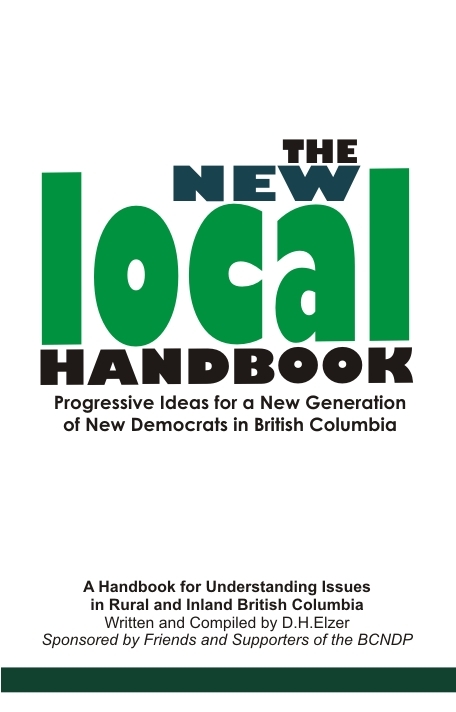
Progressive Ideas for a New Generation of
New Democrats in British Columbia
To be released October 10, 2013
Written and Compiled by D.H Elzer
With support from the Regeneration Alliance
“Creating a better future for communities, people and places of British Columbia.”
ISBN 978-0-9867444-3-3
Regeneration Alliance:
Creating a better future for communities,
people and places of British Columbia.
The New Local Handbook is made up of a series of guidebooks exposing issues and providing progressive ideas for a new generation of New Democrats in British Columbia. The guidebooks provide readers with a way of understanding issues that impact all things “local” in rural and inland British Columbia.
This series and its e-broadcasts are made possible through the support of the Regeneration Alliance, a group of hard working people who are strengthening the BCNDP by encouraging “good work” and “local” coalitions which will form a movement to create a better future for communities, people and places in British Columbia.
Introduction
This is the first book in “The New Local Handbook” series and because it’s the first, it seeks to define something that we call “The New Local”. This is a movement that has emerged that cannot be categorized within the confines of distinct parameters; politically its neither left, right or center, its part of something new, something that exists outside of the present political landscape – but something that is changing our lives.
Local has always been here, it anchors our existence, our sense of place, community and our culture. It becomes part of our spiritual center because it becomes our tangible world that includes our family, friends and neighbours. Our life is hosted by all things local as is our death and it becomes the platform by which we participate in the economy, both close to us and attached to the rest of the world.
Local is personal and creative because each of us uses all that it provides in our own unique way.
Local is now in transition because it has become known as the polar opposite of global. It is for this reason that local is strengthening and is now carrying certain expectations that it may be a vehicle that could correct certain wrongs that globalization has created. We call this transition of local, The New Local.
A handbook suggests that we are providing the reader with instruction or tools as to how to fix something; perhaps we are, but for this first book we’re offering a means by which more people can understand the workings of “local” within the context of British Columbia’s body politic.
This first book is reactive because it tells of things that are wrong or broken because it speaks to a certain distrust of power because of the layers of past empty promises and disappointments – but at the same time there is a richness that embraces hope that this will change, because beneath all that is negative there are great opportunities.
This book, by no means presents the entire picture of what’s happening in BC, it’s a narrow snapshot of a very wide landscape of issues, stories and ideas that are still untold and require exposure and strengthening. This book provides a few stories that serve as a small sample of the public discourse that has been happening for the past decade or more.
The BCNDP sustains a solid base of support that is only a few points shy of electing a government. This support seems constant no matter what the party does. The party is being elected in areas that have an inner city population and comes close to being elected in many rural and remote areas. However, its traditional organizational networks within these rural areas have eroded, meaning that there is a lack of boots-on-the-ground organizing, and a lack of knowing the local issues.
The 2013 election campaign exposed that many of the issues important to rural and remote BC remained overlooked by all political parties. The final results showed that if the BCNDP increased its vote by 10-15% in 11 rural ridings this would have changed the provincial outcome and would have moved the NDP into government with 45 seats to the Liberal’s 38. Each of these ridings is sparsely populated, which means that the NDP would need to generally attract 2-3000 new voters in each of these ridings.
So on the short term, fixing the ground campaign is important, but there’s a difference between electing a government and sustaining one on the long-term, one that is built on a set of values that is current and connects with people; and one that is robust and based on a movement driven by the grassroots – one that is “local”. The NDP are well positioned to do this, but the question is, does the party have the will?
It could be argued that here in British Columbia our democracy is threatened because our province has become too big to govern. We as a people are falling victim to the vast geography of this place, which has come to contain a growing diversity of people seeking community-determination far away from decision makers.
Rural and remote BC is enveloped within the “commons” or the huge tracks of crownland that surrounds communities and farms. This land provides the province with great financial opportunities through “tenure” agreements, which then feeds an oligarchy. Tenure reform is at the heart of any rural and local narrative that will emerge this century, however at present, no party is willing to address sweeping land tenure reforms because the majority of the electorate do no know what land tenure is, which is convenient for the oligarchy.
There is a common relationship that is shared between those living within inner cities and those in rural and remote areas. That relationship is defined by a local interdependence between all those who are defined by a strong sense of place. These groups share common concerns as external economic forces seek to adjust these places so that they may fit within the context of global profitability. If such adjustments cannot be made, then those same forces will ignore these places and the people that live within them.
This avoidance in addressing the tough issues in BC is causing this province to come apart, we need to remind ourselves that the coming apart of a society is not dramatic, it unravels very slowly and largely without notice. Even though British Columbia can be considered a wealthy province with immense opportunities, it may in fact be in decline because it has failed to rigorously diversify its regions away from resource extraction. In other words, the province is relying on the quick cash it can capture by selling off its natural equity and in the process of retaining the authority to do this, it creates complicated forms of governance that excludes people and places who consider themselves the local stewards of these same natural resources.
The events and situations that are leading to the fragmentation of British Columbia are many and they are happening constantly and they are causing a movement to emerge that will strengthen as communities and remote areas seek to solve their problems and realize opportunities independent of big government.
So one might say, our entire body politic continues to be a work in progress, which is all the more reason to understand the underpinnings of what holds it all together. The New Democratic Party needs to better understand what might be going on, off-the-beaten path. It needs to know the things that are less noticed but may be poised to change our world as our province and this land west of the Rockies continues to transform.
